Got a question?

Administration
Tjæreborg Dry Port
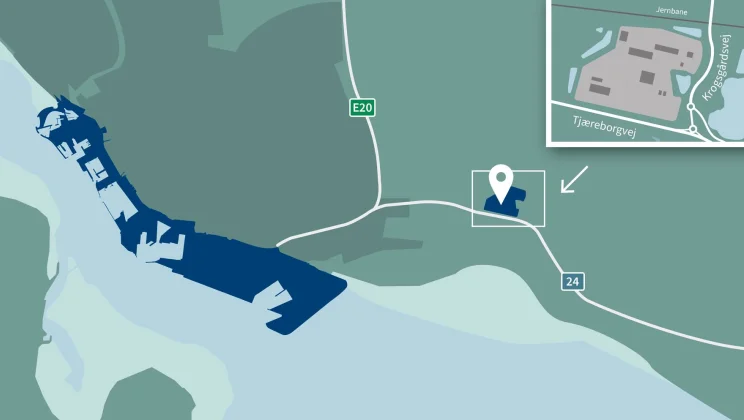
Tjæreborg Dry Port is currently awaiting political consideration.
A dry port is traditionally an area where cargo is consolidated and prepared for shipment. Dry ports are often connected to the port itself by rail and are primarily used when space within the port area is limited. While the need for additional space is also relevant for Tjæreborg Dry Port, this is neither about rail connectivity nor the consolidation of cargo for shipment.
In spring 2026, Port Esbjerg was designated at DAVOS 2026 as a Transitioning Energy Cluster. This refers to a geographically concentrated energy ecosystem where companies, energy infrastructure, the port, public authorities and research institutions work together to advance the energy transition.
As a result, new plans are also being developed for Port Esbjerg. One of these is the development of facilities for CO₂ storage, before the CO₂ is shipped to the North Sea. The North Sea has the potential to become Europe's most important region for permanent CO₂ storage and thereby a central part of the European energy transition. Significant geological storage resources, existing offshore infrastructure, strong energy clusters and proximity to heavy European industry give the region a distinct competitive advantage.
The North Sea contains both depleted oil and gas fields and deep saline aquifers suitable for the safe and permanent storage of CO₂. These formations have retained oil and gas for millions of years and are therefore also considered capable of storing large volumes of CO₂ over long periods of time.
This is particularly important for Europe because sectors such as cement, steel, refining, chemicals and waste-to-energy will continue to have residual emissions that are difficult or impossible to eliminate through electrification alone. CO₂ storage is therefore a necessary technology on the path to climate neutrality.
Before CO₂ can be shipped to the North Sea, it must be stored temporarily in cryogenic tanks. The first terminal has been established at Port Esbjerg, but additional facilities will be required in the future. The plan is for some of these tanks to be located at Tjæreborg Dry Port. Liquefied CO₂ is expected to arrive by rail from industrial facilities in Germany to Port Esbjerg and from there be transferred to the cryogenic tanks at Tjæreborg Dry Port.
Similar tanks can already be seen at Port Esbjerg. However, as space within the port area is limited, future storage facilities should be located elsewhere, allowing the port to use its areas for cargo operations, vessel handling and offshore wind projects, which are also an important part of the Transitioning Energy Cluster.
In addition, there is equipment at the port that is only used occasionally, such as lifting equipment. If such equipment is used only once a year, it is inefficient for it to occupy space on the quays where vessels are loaded and discharged. Equipment of this kind is therefore also expected to be stored at Tjæreborg Dry Port.
Finally, several major offshore wind turbine components are currently transported to Port Esbjerg via Krogsgaardsvej. Tjæreborg Dry Port will make it possible to establish new access routes funded by Port Esbjerg. This will allow components to be stored temporarily at Tjæreborg Dry Port before being transported to Port Esbjerg for shipment.
Three main activities are planned for Tjæreborg Dry Port:
- Storage tanks for liquefied CO₂, transferred to and from cryogenic tanks.
- Long-term storage of equipment that is only used occasionally.
- Temporary storage of major offshore wind turbine components.
The activities will not result in frequent traffic to and from Tjæreborg Dry Port. Nor will they require tall structures or extensive crane operations. This makes it possible to establish a landscaped screening berm around the dry port, screening the storage areas from view and minimising their visual impact on the surrounding area.
Finally, it should be emphasised that CO₂ storage is crucial to future activities in the North Sea. It is an integral part of the EU's Carbon Management Strategy and will support activity in the North Sea for many decades to come.
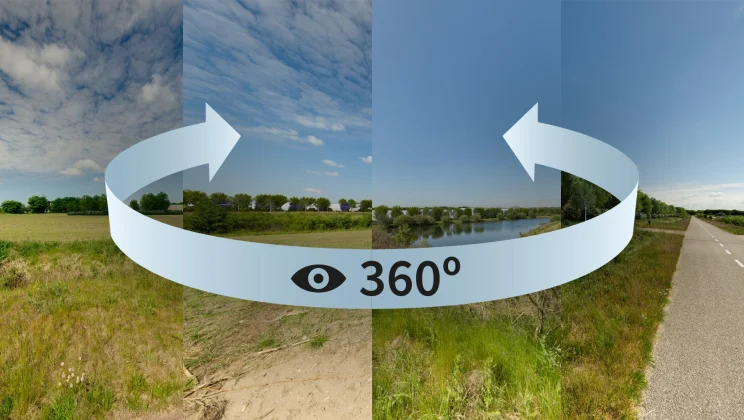
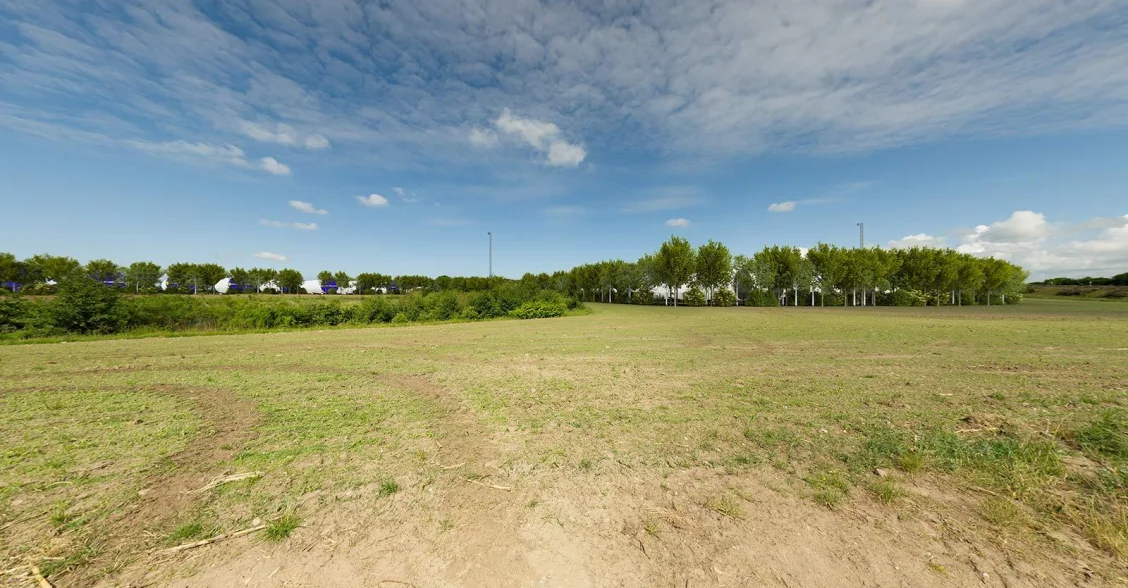
See the future dry port in virtual reality:
Click to see: